




Want to ride an electric moped on public roads in Europe? Before your first journey, it's important to understand the legal requirements that apply to your vehicle and your country.
For an L1e-B electric moped with a maximum design speed of 45 km/h, having the right vehicle documentation is only the first step. Depending on where you live, you may also need to arrange insurance, complete vehicle registration, obtain the appropriate driving licence and follow local riding regulations.
This guide explains what a COC (Certificate of Conformity) is, what you need to prepare before riding, and how L1e-B electric mopeds are registered in Germany, Austria, France, the Netherlands, Spain, Italy, Poland and Great Britain. We'll also compare the main riding requirements in these markets to help you understand what to check before getting on the road.
Can You Ride an Electric Moped on Public Roads in Europe?
Yes, you can ride an electric moped on public roads in many European countries, provided that the vehicle meets the applicable road approval requirements and you complete the necessary legal procedures. However, owning an electric moped does not automatically mean you can ride it on public roads.
For an L1e-B electric moped with a maximum design speed of 45 km/h, several requirements may apply before your first ride. These generally include:
- Vehicle approval: Your electric moped must meet the applicable vehicle approval requirements for the country where you intend to ride.
- COC documentation: A Certificate of Conformity (COC) provides important information about the vehicle and its conformity with an approved vehicle type.
- Vehicle registration or insurance plate: Depending on the country, you may need to complete formal vehicle registration or obtain a specific insurance plate before riding.
- Motor vehicle insurance: Compulsory third-party liability insurance is generally required for public-road use.
- Driving licence: You must hold the appropriate driving entitlement for an L1e-B electric moped. Minimum age requirements and accepted licence categories vary between countries.
- Riding equipment: An approved helmet is generally required, while some countries may have additional equipment requirements.
What Is COC Certification, and Why Does It Matter?
One of the first terms you'll encounter when researching road-legal electric mopeds in Europe is COC. COC stands for Certificate of Conformity. It's a document confirming that a vehicle conforms to an approved vehicle type. It contains important vehicle information used in relevant insurance and registration procedures.
The L1e-B category covers two-wheeled mopeds, including qualifying electric mopeds with a maximum design speed of 45 km/h. This classification matters because an L1e-B electric moped is not treated as an ordinary electric bicycle.
What Does L1e-B Mean for Riders?
Public-road use of an L1e-B electric moped involves requirements that go beyond those of a conventional electric bicycle. These can include an appropriate driving licence, compulsory motor vehicle insurance, a registration or insurance plate, and approved protective equipment. The exact administrative process depends on where you live.
Why Should You Keep Your COC?
Your COC is one of the key documents to have ready when arranging registration or insurance. Depending on the country, you may also need your purchase invoice, vehicle identification number (VIN), proof of identity and other supporting documents. Keeping your COC safe from the beginning can make the process easier.
Does a COC Mean Your Electric Moped Is Ready for the Road?
Not by itself. A COC supports the vehicle's conformity documentation, but it doesn't replace registration, insurance or the rider's licensing requirements. For example, Germany generally uses a special insurance plate for qualifying mopeds, while France requires a formal registration certificate. So the next step is to understand what your country requires before you ride.
Before Your First Ride: Four Essentials to Prepare
The paperwork may look different from country to country, but there are four areas every prospective L1e-B electric moped rider should consider.
Vehicle Documents
Keep your COC, purchase invoice and VIN information available. These documents may be requested during insurance or registration.
Driving Licence
An appropriate moped driving entitlement is required for public-road use. The AM category is commonly relevant, although minimum ages and recognition of other licence categories differ by country.
Insurance and Number Plate
Compulsory motor vehicle liability insurance is required. Depending on your location, you'll need either an insurance plate or a formally registered number plate before using the vehicle on public roads.
Riding Equipment
An approved helmet is required, and some countries have additional protective equipment rules. We'll compare the main age, licence and riding requirements after looking at the registration procedures.
How to Register an L1e-B Electric Moped in Eight European Markets
There isn't a single registration procedure that applies identically across Europe. In Germany, the standard route for qualifying mopeds is through an insurance provider. In France, registration is handled online through ANTS. In the Netherlands, RDW is responsible for vehicle registration.
Here's a quick overview.
| Country | Main authority or provider | Registration approach |
|---|---|---|
| Germany | Moped insurance provider | Obtain an insurance plate |
| Austria | Zulassungsstelle | Register the vehicle and obtain a plate |
| France | ANTS | Complete formal registration |
| Netherlands | RDW | Register the vehicle and obtain a yellow plate |
| Spain | DGT | Register the vehicle before arranging insurance |
| Italy | Motorizzazione Civile | Apply for registration and a plate |
| Poland | Wydział Komunikacji | Complete local vehicle registration |
| Great Britain | DVLA | Submit a new vehicle registration application |
Germany: Start With Your Insurance Plate
Germany has a relatively straightforward system for qualifying L1e-B electric mopeds. In the standard arrangement, you don't need to complete conventional vehicle registration. Instead, you obtain a Versicherungskennzeichen, a special moped insurance plate.
Start by contacting an insurer offering moped liability insurance. Providers such as HUK-COBURG, ADAC, Allianz, WGV and LVM are among the options available. You'll need to provide the requested vehicle information, including details such as the VIN. Keep your COC ready as supporting documentation. Once the insurance is arranged, you'll receive the appropriate insurance plate to fit to your vehicle. One detail to remember is that German moped insurance follows an annual cycle from 1 March to the end of February. The insurance plate must be renewed for the new period.
Germany also has an alternative route called freiwillige Zulassung, or voluntary registration. If you choose formal registration instead of the standard insurance plate arrangement, you'll need to follow the additional procedure through your local Zulassungsstelle.
Austria: Prepare Your Documents Before Registration
For Austria, the registration requirements described for L1e-B electric mopeds apply from 1 October 2026. The process involves entering the vehicle's information into the Austrian approval database, arranging compulsory motor vehicle liability insurance and completing registration.
Start by preparing your COC and purchase invoice. The vehicle information must be entered into the Genehmigungsdatenbank, Austria's vehicle approval database. Once this has been completed, arrange the required Kfz-Haftpflichtversicherung with an insurance provider. You'll then need to take the required documents and insurance confirmation to an authorised Zulassungsstelle to complete registration. After the application is processed, you'll receive the relevant registration documents and number plate.
France: Getting Your Carte Grise
In France, an L1e-B electric moped is known as a cyclomoteur. To prepare it for road use, you'll need compulsory insurance and a formal registration certificate. The process is handled through ANTS, France's online vehicle registration system.
Begin by gathering your COC, purchase invoice, VIN, identification and the other information required for the application. Next, arrange the appropriate moped insurance. Providers such as AMV, MAIF, Macif and Matmut are among the options you can explore. With the insurance confirmation ready, you can proceed with the ANTS registration application. Once the registration is completed, you'll receive your certificat d'immatriculation, commonly known as the carte grise. You'll also need the appropriate registration plate before riding on public roads.
Netherlands: Registering Your Bromfiets
In the Netherlands, an L1e-B electric moped is generally called a bromfiets. The registration authority is the RDW, which handles vehicle registration and the associated number plate process. You'll need to prepare your COC, purchase invoice, VIN and identification details. Compulsory third-party liability insurance, known as WA-verzekering, is also required. After arranging the necessary insurance and completing the RDW registration procedure, the vehicle receives its registration information and the relevant yellow number plate.
Spain: Registration Comes Before Insurance
In Spain, an L1e-B electric moped is classified as a ciclomotor. The registration process is handled by the Dirección General de Tráfico (DGT). One important difference from several other countries is the order of the process.
In Spain, you register the vehicle first and then arrange insurance using its registration details. Begin by preparing the COC, purchase invoice, identification and the relevant technical and tax documentation. Next, complete the DGT registration procedure to obtain the vehicle's registration information and official number plate. Once registration has been completed, arrange the compulsory motor vehicle insurance before using the vehicle on public roads.
Italy: Registering Your Ciclomotore
In Italy, an L1e-B electric moped is known as a ciclomotore. The registration procedure is handled through the Motorizzazione Civile. You'll need the COC, purchase invoice, identification and the other documents required for the application. The process includes the relevant TT2118 form. Once registration is completed, you'll receive the certificato di circolazione and the vehicle's targa, or number plate. Compulsory motor vehicle insurance must also be active before riding on public roads.
Poland: Vehicle Registration and OC Insurance
In Poland, an L1e-B electric moped is classified as a motorower. Registration is handled through the local Wydział Komunikacji, or vehicle registration department. Prepare your COC, purchase invoice or sales agreement, identification and the information required for the registration application. You'll also need compulsory third-party liability insurance, known as OC. This insurance can be arranged before registration or on the registration day, but it must be active before the vehicle is used on public roads. The registration procedure includes a temporary registration certificate and number plate, followed by the permanent registration document.
Great Britain: Registering an L1e-B Electric Moped With the DVLA
Great Britain follows a separate vehicle approval and registration system from the European Union. For an L1e-B electric moped to be registered for road use in England, Scotland or Wales, the vehicle must meet the applicable GB approval and registration requirements. Vehicle registration is handled through the Driver and Vehicle Licensing Agency (DVLA).
For a new L1e-B electric moped, the registration process involves preparing the relevant documents, including:
- V55/4 registration form
- Certificate of Conformity (COC)
- Applicable GB type-approval documentation
- Certificate of Newness
- Commercial invoice
- Vehicle identification information
- Insurance documentation
The completed application is submitted to the DVLA together with the applicable registration fee and vehicle tax payment. Electric motorcycles and mopeds became subject to vehicle tax from 1 April 2025.
The registration information includes an indicative first registration fee of approximately £55 and annual vehicle tax of around £27, although the actual amounts should be confirmed when applying. After registration, you'll receive the relevant documentation, including the V5C, and can fit the appropriate number plate.
Driving Licences and Riding Rules: A Quick Country Comparison
Once you've understood the registration process, the next question is whether you're personally eligible to ride. Minimum ages, licence entitlements and protective equipment requirements vary between countries. The table below brings the key information together in one place.
| Country | Minimum age | Main licence information | Riding requirements |
|---|---|---|---|
| Germany | 16 | AM, A1 or qualifying B | Approved helmet |
| Austria | 15 | AM | Helmet required; no ordinary cycle paths |
| France | 14 | AM or recognised B entitlement | Helmet and CE-certified gloves |
| Netherlands | 16 | AM or qualifying B | Helmet required; follow bromfiets road rules |
| Spain | 15 | AM or qualifying B | Helmet; additional glove and footwear rules |
| Italy | 14 | AM or qualifying B | Approved helmet |
| Poland | 14 | AM or qualifying B | Helmet; no cycle paths or pavements |
| Great Britain | 16 | Appropriate moped entitlement; CBT where required | Helmet; L-plates where applicable |
A Few Details Worth Remembering
Having a car driving licence doesn't automatically settle the question. Recognition of B-category entitlements depends on the country and the licence held.
Protective equipment rules are not identical everywhere. France requires CE-certified protective gloves. Spain has additional glove and footwear requirements identified from 1 October 2026.
An L1e-B electric moped isn't treated like an ordinary bicycle. In Austria, the Netherlands and Poland, the applicable rules restrict the use of ordinary bicycle paths.
Great Britain has additional rider requirements. Depending on your driving entitlement, Compulsory Basic Training (CBT) may be required. A CBT certificate is generally valid for two years, and L-plates must be displayed where applicable.
Before your first ride, check the requirements that apply to your vehicle category and driving entitlement.
Which HITWAY Electric Moped Is Right for You?
Now that you understand the COC documentation, registration procedures and riding requirements for L1e-B electric mopeds across different European markets, you may be ready to explore your options.
If you're looking for an electric moped with dirt-bike-inspired styling, the HITWAY HT500 and HT300 offer two different configurations to consider. Both models have a maximum speed of 45 km/h and feature three selectable speed settings, making them worth comparing if you're looking for an L1e-B electric moped.
HITWAY HT500 vs HT300: Which One Should You Choose?
Both models share several key features, including a maximum speed of 45 km/h, three speed settings, hydraulic disc brakes and a maximum load capacity of 120 kg. The main differences are motor power, battery capacity and vehicle weight.
| Feature | HITWAY HT500 | HITWAY HT300 |
|---|---|---|
| Motor Power | 2.5 kW | 2.0 kW |
| Battery Capacity | 1,620 Wh | 1,296 Wh |
| Maximum Speed | 45 km/h | 45 km/h |
| Speed Settings | 25 / 35 / 45 km/h | 25 / 35 / 45 km/h |
| Net Weight | 64.5 kg | 49.1 kg |
| Maximum Load | 120 kg | 120 kg |
| Brakes | Hydraulic disc brakes | Hydraulic disc brakes |
| Water Resistance | IPX4 | IPX4 |
Choose the HITWAY HT500 if: You prioritise higher motor power and greater battery capacity.
Choose the HITWAY HT300 if: You prefer a lighter vehicle while still having a 2.0 kW motor and a 1,296 Wh battery.
Ready to Explore Your Next Ride?
Whether you prefer the higher power and battery capacity of the HT500 or the lighter design of the HT300, you can explore both models and compare their features to find the one that best matches your preferences.
Explore the HITWAY HT500 & HT300
Two electric mopeds. Different configurations. Find the one that suits you.
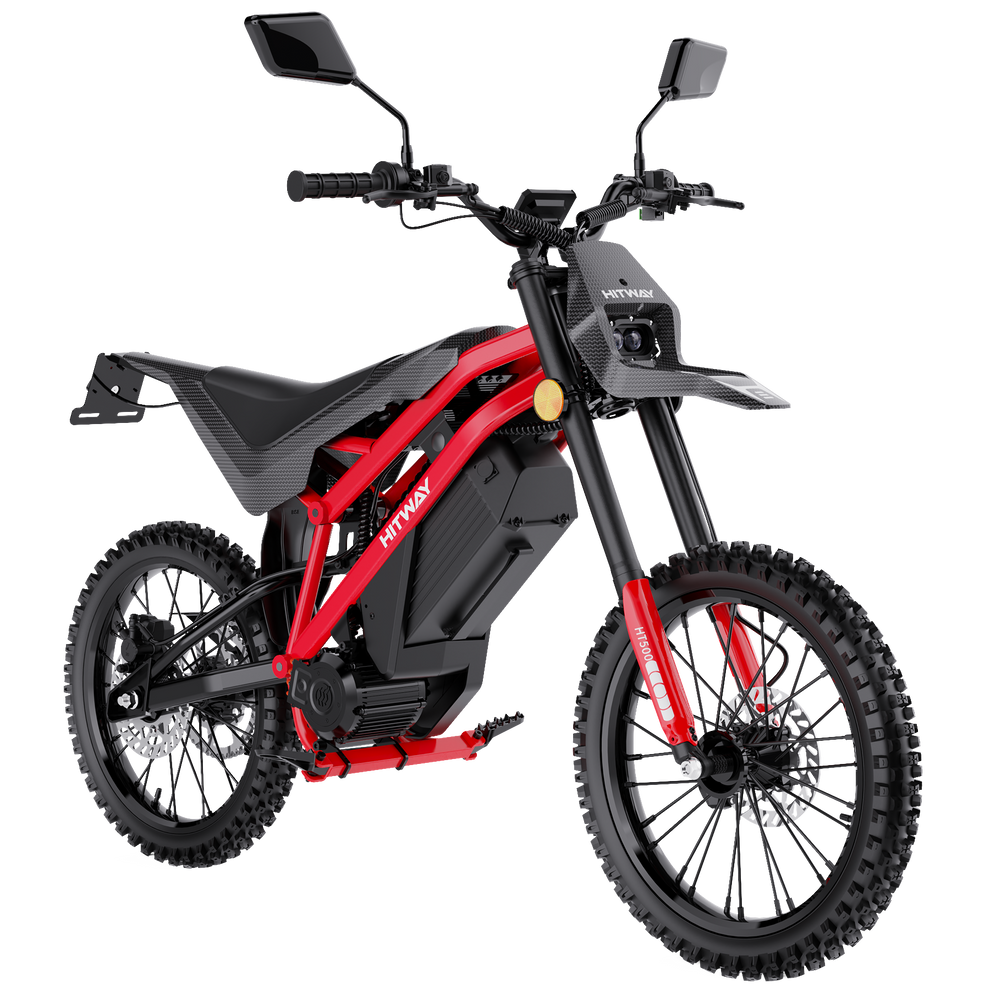
HITWAY HT500
Greater motor power and battery capacity.

HITWAY HT300
A lighter, more compact electric moped.
FAQ
Do the HITWAY HT500 and HT300 come with a COC?
Yes. Both the HITWAY HT500 and HT300 come with a Certificate of Conformity (COC). You won't need to apply for this document separately after purchasing your vehicle. The COC contains important vehicle identification and conformity information. Keep it safe after delivery, as you may need it when arranging insurance or applying for vehicle registration in your country.
Can I ride my HT500 or HT300 while waiting for my registration or number plate?
No. You should not ride your HT500 or HT300 on public roads until you have completed the applicable legal requirements in your country. Even if your vehicle has arrived and you have received its COC, you may still need to arrange compulsory insurance and obtain the required insurance or registration plate. The exact process depends on your country. Before your first public-road ride, make sure all the necessary steps have been completed.
Can I use my car driving licence to ride an HT500 or HT300?
It depends on the country where you plan to ride. Some countries recognise certain car driving licences (Category B) as sufficient for riding an L1e-B moped, while others require a specific AM moped entitlement. Conditions may also depend on your age and when or where your driving licence was issued. Check the driving licence requirements for your country before purchasing or riding your vehicle. You can also refer to our country comparison table for a quick overview.
What should I do if my country has additional requirements for registering an L1e-B moped?
Registration requirements can vary depending on your country and, in some cases, your local registration authority. If you find that your country requires additional documents or approval procedures, check the requirements with the relevant vehicle registration authority before starting your application. Make sure you have your COC, purchase invoice, vehicle identification information (VIN) and any other requested documents ready.